Imagine the following scenario.
A financial services organisation notices unusual activity within one of its digital platforms. At first, the indicators appear minor.
- A few suspicious login attempts.
- Several unusual API requests.
- A handful of alerts from different security systems.
Nothing appears serious in isolation.
Within hours, however, the organisation discovers that sensitive information may have been exposed through a third-party integration.
Security teams begin investigating. Management asks for answers. Regulators require updates. Business operations are disrupted. Customers start asking questions.
Suddenly, the organisation faces a challenge that extends far beyond technology.
The question is no longer: “What tool should we use?” Instead, the question becomes: “Do we understand what happened, what risks we face and what actions we should take next?”
This is where many cybersecurity programmes struggle. Not because organisations lack security tools. But because critical cybersecurity capabilities often operate separately rather than together.

The Challenge Isn't a Lack of Technology
Many organisations have invested significantly in cybersecurity over the years. They have:
- Security monitoring solutions
- Compliance tools
- Threat intelligence feeds
- Investigation platforms
- Security policies
Yet cyber incidents continue to increase in complexity. Today's threats move across multiple environments, organisations and technologies.
A single incident may involve:
- Cloud infrastructure
- Third-party vendors
- User credentials
- Artificial intelligence tools
- Blockchain transactions
- Multiple jurisdictions
When visibility becomes fragmented, decision-making becomes slower. And when decision-making slows down, operational risk increases.
Capability One: Govern
Every cybersecurity programme starts with governance. Leaders need answers to important questions:
- What are our most significant cyber risks?
- Which systems matter most?
- Who owns each risk?
- What controls are currently in place?
- Where do the greatest exposures exist?
Without governance, organisations often struggle to prioritise resources or understand their actual risk profile. Cybersecurity becomes reactive instead of strategic.
Governance creates the foundation for informed decisions. It helps transform cybersecurity from a technical activity into an organisational capability.
Capability Two: Know
Governance alone does not provide real-time awareness. Organisations must also understand what is happening around them.
Threat actors move quickly. Attack techniques evolve. New vulnerabilities emerge daily.
The challenge is no longer obtaining information. The challenge is identifying which information actually matters.
Security teams are often overwhelmed by:
- Threat feeds
- Security alerts
- External intelligence
- Vulnerability reports
- Operational data
Without context, teams can struggle to separate meaningful signals from background noise.
Threat intelligence helps organisations make better decisions by transforming information into understanding. Knowing what matters allows organisations to respond faster and prioritise more effectively.
Capability Three: Investigate
Even organisations with strong governance and threat visibility will eventually face incidents that require investigation. When that happens, questions become critical:
- What happened?
- Who was affected?
- What systems were involved?
- How did the incident occur?
- What evidence supports our findings?
As digital ecosystems become more connected, investigations increasingly require specialised capabilities. This is particularly true when incidents involve financial crime, blockchain transactions, digital assets or complex cross-platform activity.
A successful investigation provides more than technical findings. It creates clarity. It enables accountability. And it supports better future decisions.
Why These Capabilities Must Work Together
Returning to our opening scenario:
Imagine the organisation possessed strong threat intelligence but weak governance. The threat might be identified. However, leadership may struggle to prioritise actions or understand business impact.
Now imagine the organisation had strong governance but limited investigative capability. Leadership might understand the risk. But the organisation may not know what actually happened.
Neither outcome is sufficient.
Cyber resilience requires all three capabilities working together:
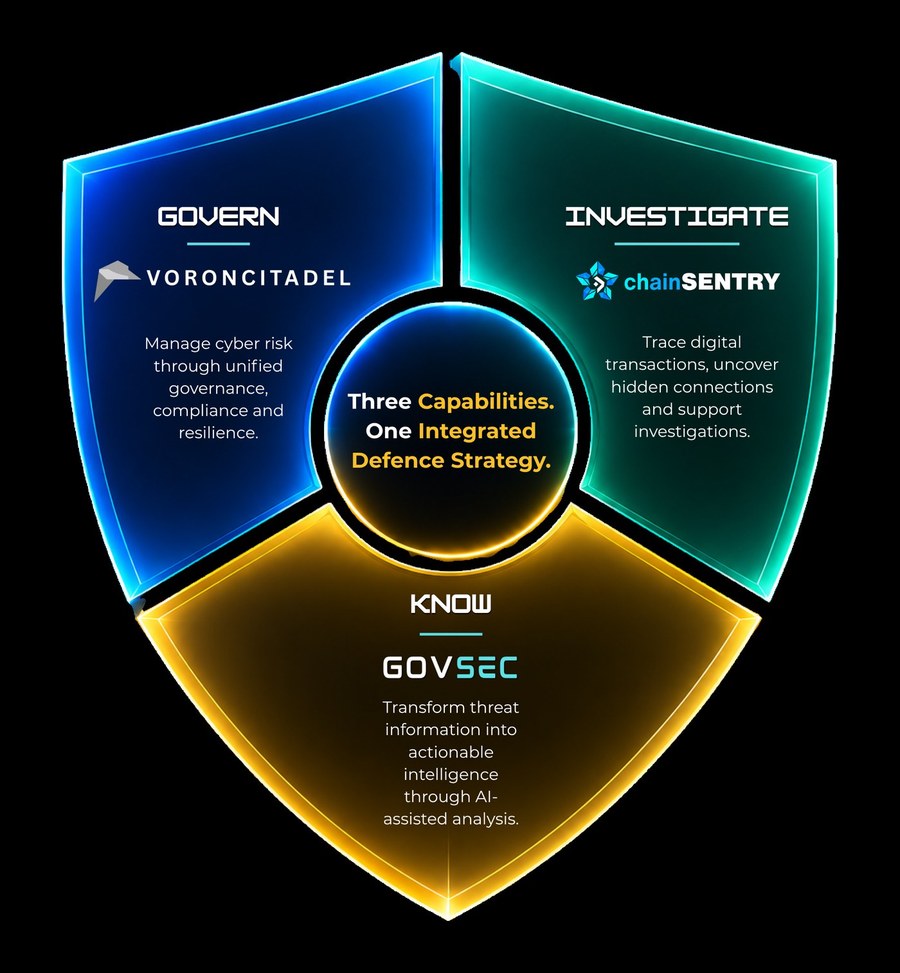
- Govern: Understand risks and responsibilities.
- Know: Understand threats and changes in the environment.
- Investigate: Understand incidents and establish facts.
Together, they create a continuous cycle of visibility, decision-making and response.
Building Cyber Resilience for the Digital Era
Cybersecurity today is not simply about preventing attacks. It is about maintaining trust. It is about maintaining operational continuity. And it is about making informed decisions under pressure.
As organisations navigate increasingly complex digital environments, the ability to Govern, Know and Investigate becomes essential.
These three capabilities formed the foundation of the Sovereign Cybersecurity Capability introduced by Aras Integrasi at CyberDSA 2026 through:
- VoronCitadel | Govern
- GovSec | Know
- chainSENTRY | Investigate
While each platform addresses a distinct challenge, together they reflect a simple principle: “Cyber resilience is strongest when governance, intelligence and investigation work together.”
In a world of rapidly evolving threats, that principle may prove just as important as the technologies themselves.