Anugerah Kreatif Aspirasi Reka (AKAR 2026) is Yayasan KRU's flagship nationwide initiative designed to nurture youth creativity, bridge the digital divide, and champion environmental conservation from an early age. Organized in close collaboration with the Ministry of Education, PTPTN, KEMAS, and JPNIN, the programme engaged preschool and primary school students across all 13 states and 3 federal territories in physical drawing and colouring competitions centered on wildlife protection.
However, the initiative's rapid grassroots adoption created an unprecedented operational bottleneck. 175,531 students registered and each of their artworks required evaluation against standardized, age-specific rubrics within a strict 21-day judging window.
To solve this, Aras Integrasi engineered Malaysia's first nationwide AI-assisted competition evaluation platform. Powered by NVIDIA-accelerated GPU infrastructure, the platform balanced national-scale automated processing with strict human oversight, ensuring that every child's work was evaluated fairly, securely, and on schedule.
The Solution: Human-in-the-Loop AI on NVIDIA GPUs
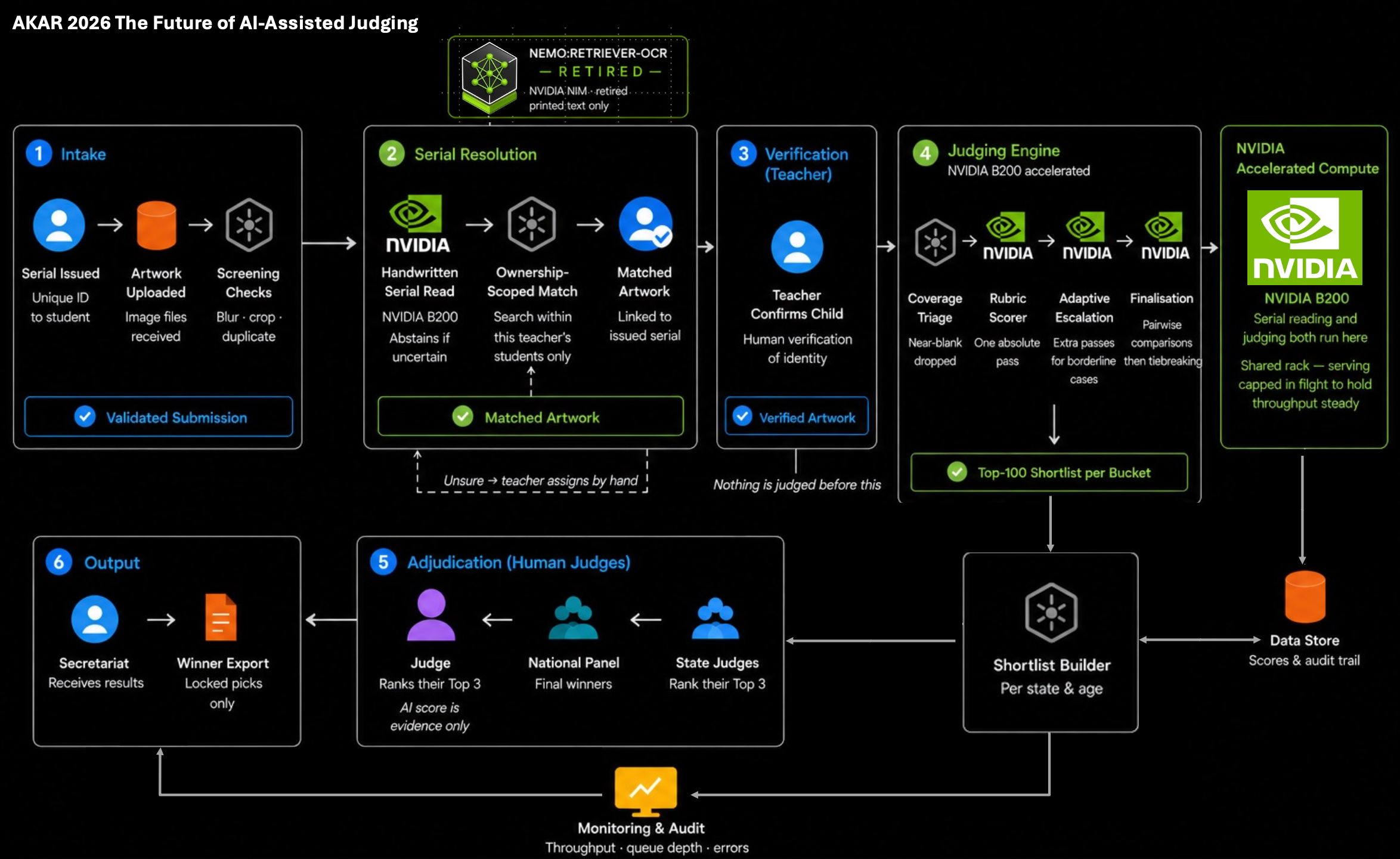
Evaluating children's artwork required moving beyond static, off-the-shelf tools. We implemented an end-to-end, human-gated architecture based on a core rule: AI for scale, humans for accountability.
Architecture & Engineering Highlights
- Deterministic Screening & Intake: Submissions were initially screened via automated image processing routines to filter out blur, incorrect orientation, cropping defects, and duplicate entries before utilizing GPU resources.
- Text Extraction & Safeguards: The pipeline initially integrated NVIDIA NIM nemoretriever-ocr microservices across pooled replica containers for printed text recognition. Because young children handwrote their assigned serial codes onto the physical sheets, serial recognition was transitioned to Vision-Language Models (VLMs) calibrated with an "abstain-over-guess" safeguard, routing ambiguous handwriting to teachers for verification.
- NVIDIA GPU Acceleration Layer: High-throughput evaluation ran on 8 NVIDIA B200 GPUs hosting 8 containerized vLLM instances behind a LiteLLM proxy layer, serving fine-tuned Qwen3.6-27B multimodal models.
- Asynchronous Queue Management: Heavy model inference was completely decoupled from client ingestion using durable PostgreSQL worker queues and Redis caching, ensuring high throughput without database lock contention.
We Measured the Gap
We benchmarked both paths on 3,000 submissions, same image bytes, same scoring, all ten digits required:
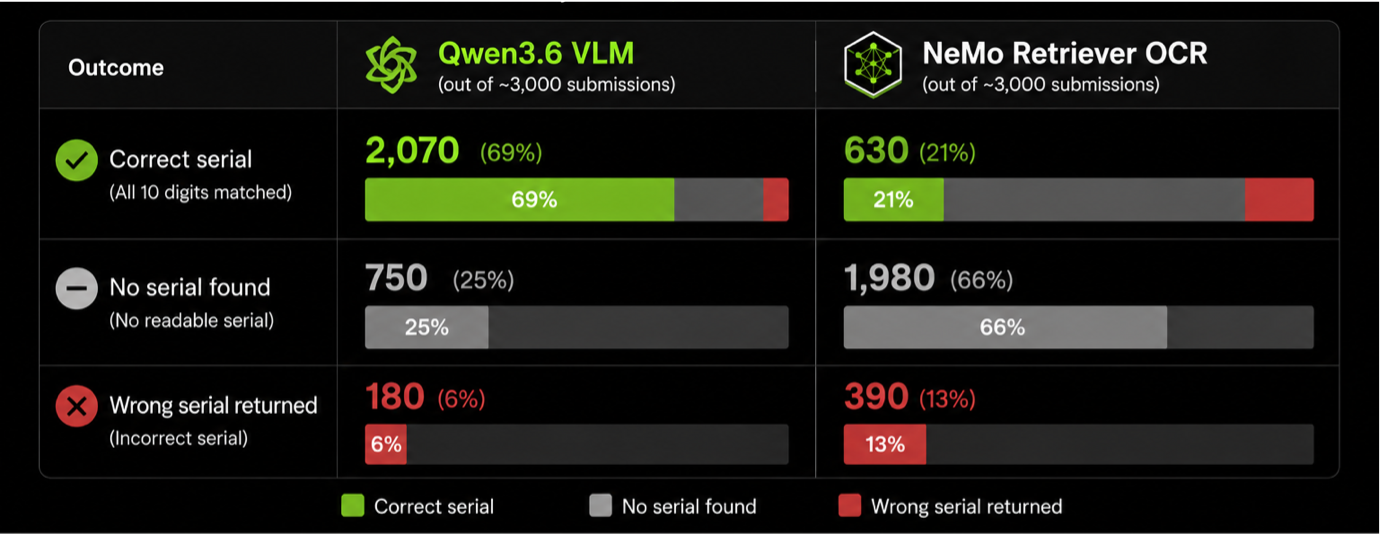
- The failure pattern matters more than the accuracy gap. NeMo Retriever reliably extracted printed text, including the "No. Siri AKAR:" label, but struggled with the adjacent handwritten serial. This suggests the limitation is handwritten text recognition, not OCR or post-processing.
- At AKAR scale (3,000 submissions), this difference is significant. If the benchmark rates hold, Qwen3.6 VLM would automatically match 2,070 artworks compared with 630 for NeMo Retriever, reducing manual intervention by approximately 1,440 submissions.
- Ground truth was independently verified. Serial numbers were manually assigned and confirmed by teachers before evaluation, ensuring both systems were measured against the production reference rather than each other.
Results & AI Impact: Quality, Speed, and Fairness
Deploying NVIDIA-accelerated AI transformed a mathematically impossible manual review process into a high-precision, transparent pipeline.
- 175,531 artworks processed across 48 buckets consisting of 13 states and 3 federal territories by three age categories.
- 4,800 shortlisted, the top 100 per bucket and handed to 48 state judges, producing 144 state winners for a three-judge national panel.
- 69% of handwritten serials read automatically, against 21% for printed-text OCR on the same images.
- 41% fewer model calls than the fixed-depth scoring approach it replaced, at equal or better top-100 recall.
The Judge Sees the Artwork, Not the Child
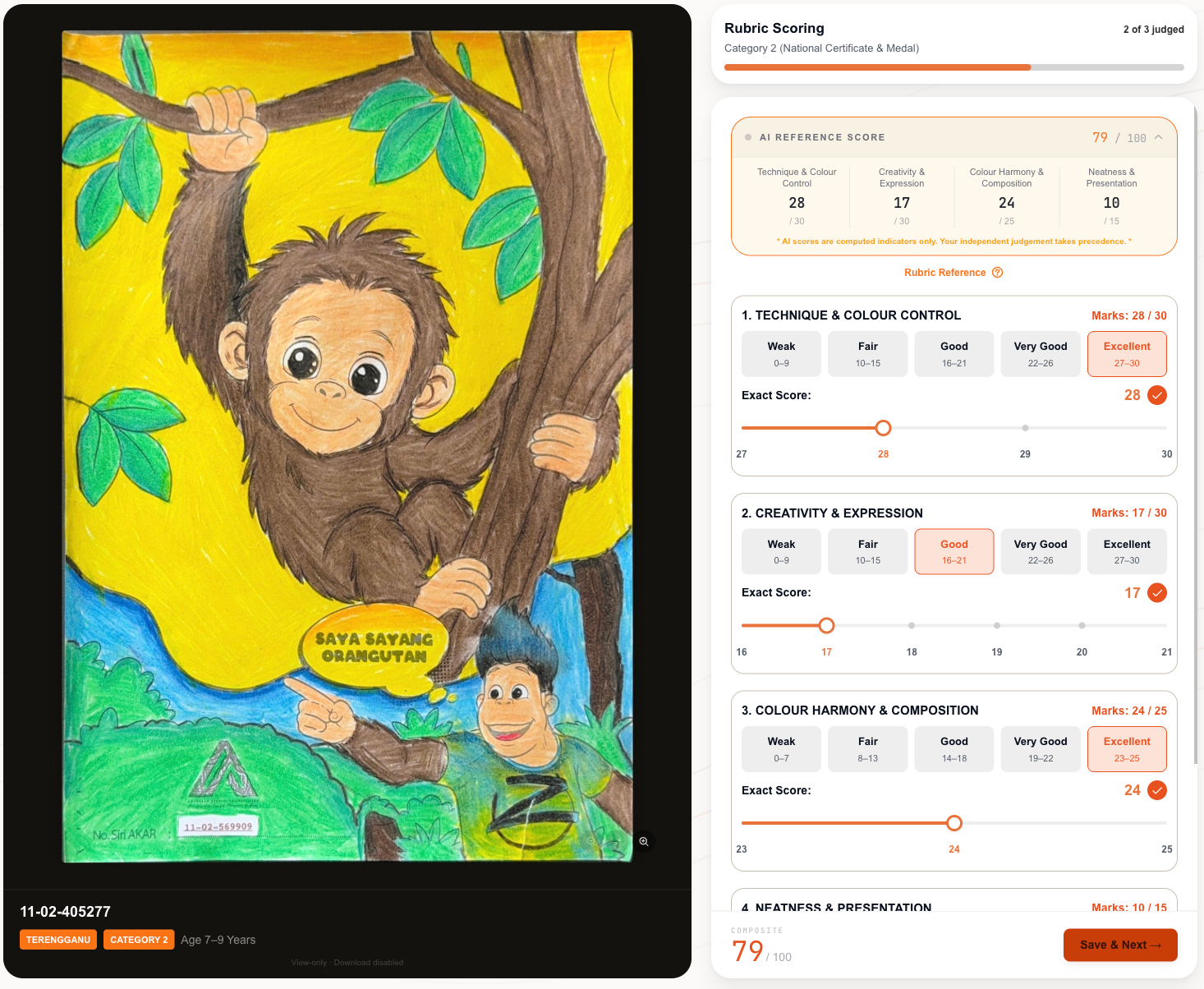
Every piece reaches a judge under its serial number alone, no name, no school, and no teacher information is accessible by the judge. The only attributes shown are the ones the rubric structurally requires: the state and age category that define the bucket being judged. PDPA consent is recorded server-side at registration with a timestamp and the declaration version, not left to a checkbox the browser forgets. The scoring model works under the same constraint that it receives an image and a rubric, never a child's identity.
How the Judging Was Kept Clean
The AI hands over 48 shortlists. Everything after that is human, and the constraints are enforced in the database rather than the interface.
One bucket, one judge: Each state-and-category pairing belongs to exactly one judge, a unique index makes overlapping assignments impossible rather than merely discouraged.
No inherited ranking: Judges see an unsorted shortlist. The AI's per-criterion score and justification sit in a side panel as reference, never as a pre-filled default, and its ranking is never shown, so nobody inherits the machine's ordering.
Separate tables: Human scores are written to a different table from the AI's, so a judge can't overwrite a model output and a model can't overwrite a judge.
Conflict exclusion at query level: An artwork from a judge's own school is never returned to them, so it can't be filtered back in.
Immutable picks: When a judge has dragged their final Top 3 into place after providing their comments, they lock the bucket. The rows become read-only and the picks freeze. There is no unlock endpoint.
Every registration, reassignment, resubmission, judge transfer and admin action is written to an append-only audit log. Teachers, meanwhile, see only whether an artwork has been judged, never a score, never a rank.
Social Impact: Inspiring Young Creators at National Scale
Beyond the technology, AKAR 2026 delivered measurable social impact for children, families, and educators across Malaysia:
- Democratizing Creative Recognition: Reached 175,531 registered students across urban centers and rural districts alike, providing equal visibility to children regardless of geographic location.
- National Heritage & Educational Savings: All competition prize funds were disbursed directly into winners' SSPN (National Education Savings Scheme) accounts, connecting early artistic achievement to long-term financial security for higher education.
- Official Recognition by the Malaysia Book of Records: Officially recognized as the largest creative talent competition in Malaysia and the country's first nationwide competition judged with the assistance of AI. Registered students was 153,056 during the opening ceremony on 1st July 2026.
- Preserving Trust & Child Privacy: Engineered with strict privacy-by-design principles, ensuring zero exposure of minors' personal data to judges or automated scoring models.
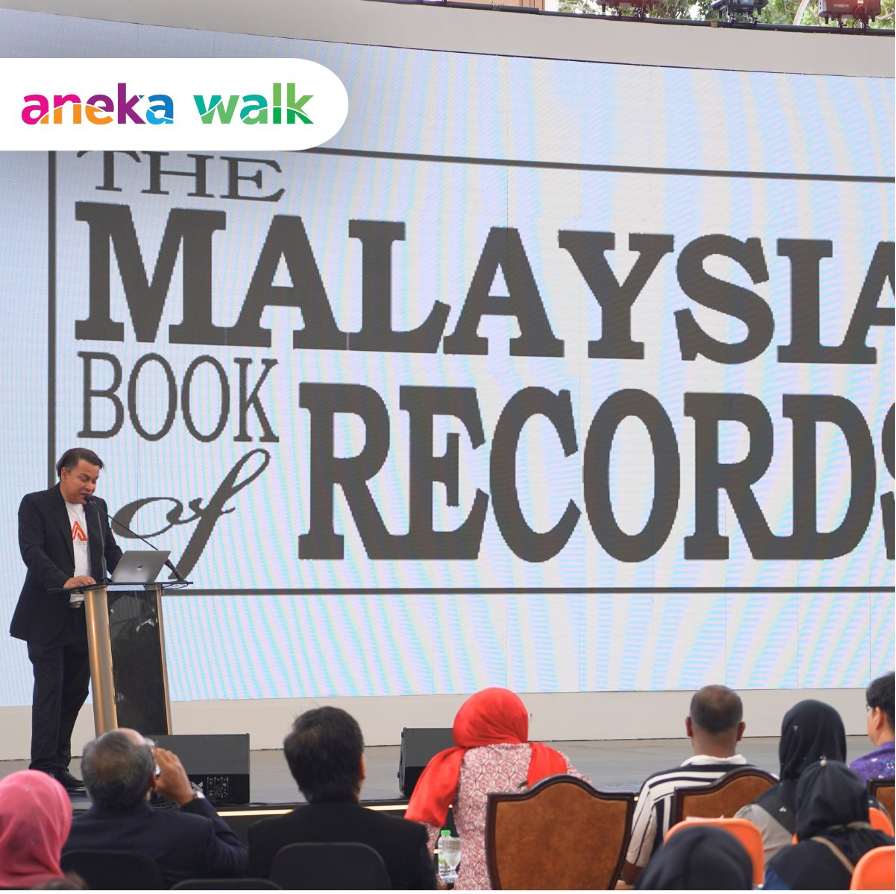 Image by: aneka walk
Future Opportunities: Expanding the Pipeline
The operational success of AKAR 2026 proved that GPU-accelerated AI infrastructure can manage complex, national-scale evaluations while upholding human accountability and child privacy.
Following this milestone, Aras Integrasi and Yayasan KRU are preparing for next year's competition cycle:
- Expanding Scope: Broadening eligibility to include secondary schools and higher education institutions nationwide.
- Handling Larger Scale: Scaling the NVIDIA-accelerated architecture to support a substantially larger submission volume.
- Advanced Multimodal Evaluation: Expanding automated multimodal rubric evaluation to handle complex multi-page creative projects, digital art, and extended narrative submissions.
With NVIDIA's accelerated infrastructure and Aras Integrasi's commitment to responsible AI, we're not just optimizing competition scale — we're setting a new benchmark for how technology can nurture, protect, and empower the creative potential of every child.